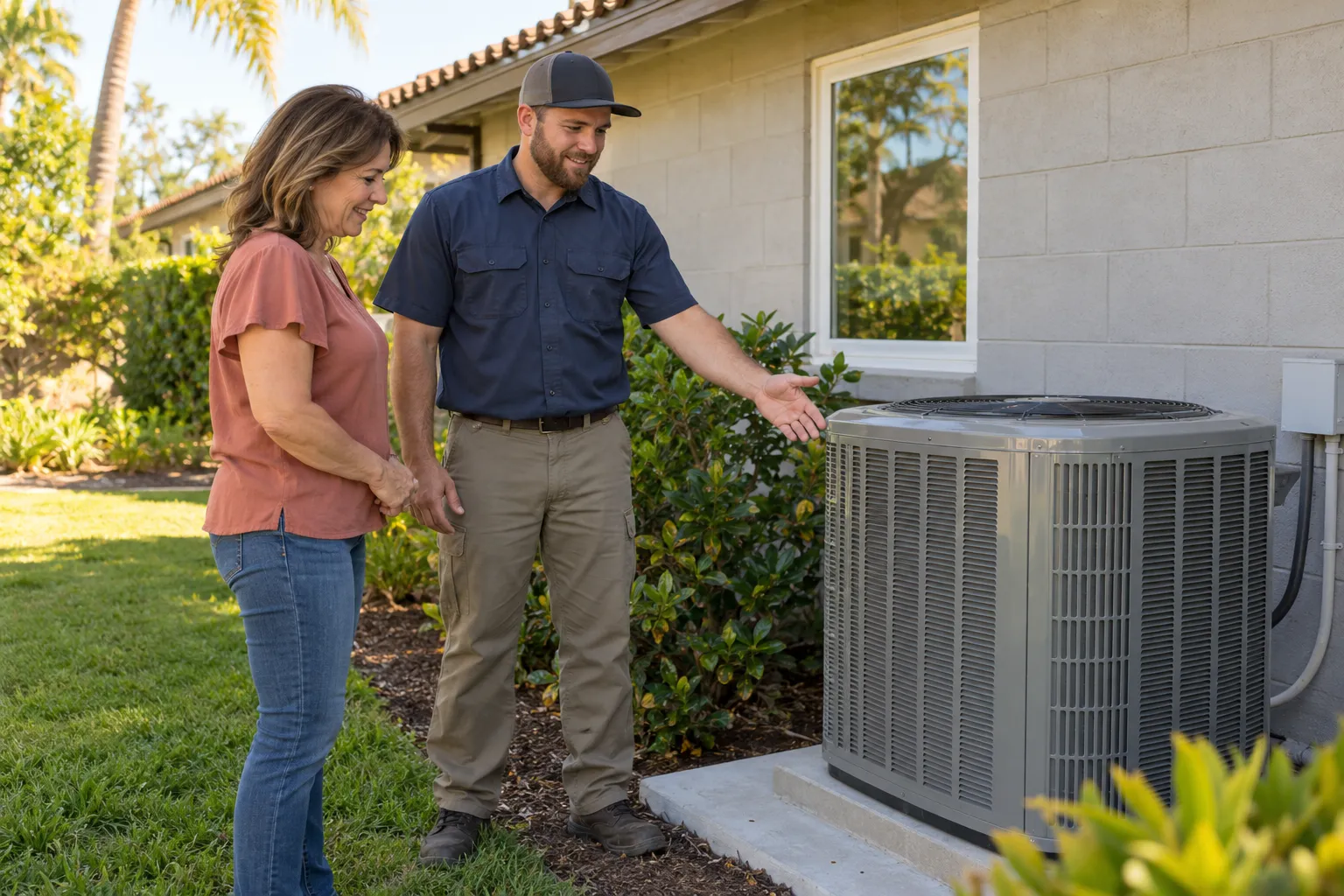
AC Installation and Replacement Near You
Request an estimate from a local provider
A dead air conditioner in a humid climate feels urgent, and it can be. Indoor air warms up, moisture builds, and the house gets sticky fast. The good news is that you do not have to decide everything in the first hour. You only need to know what to check and who to ask.
Desperateangeles Heating & Air is a referral service. We explain what is likely happening, then connect you with an independent HVAC service provider in the Tampa area. The provider inspects your system, talks through repair and replacement, and gives you a written quote. Providers do the work. This page walks you through the signs, the system types, sizing, and the questions worth asking before you say yes.
Pause, then check: is the AC really finished?
It helps to think of a stalled car. Before you call a tow truck, you check the fuel. Your AC deserves the same pause.
Look at the thermostat first. Make sure it is set to cool and the batteries are fresh. Then check the breaker for the indoor and outdoor units. Finally, look at the air filter. A clogged one can make a healthy system shut down. If none of this helps, the problem is bigger than a quick fix.
Why a warm house gets uncomfortable so quickly here
In a humid climate, your AC does two jobs. It cools the air, and it pulls water out of it. Think of it as a sponge that also holds a fan. When it stops, the sponge dries out and the moisture floods back in.
Concrete block homes on slabs hold heat well, which is nice in winter but slow to shed in summer. Add almost daily storms and the air inside can feel heavy within hours.
What happens hour by hour if you wait
In the first few hours, the house warms and the air feels sticky. Close blinds, run fans, and drink water.
By the next day, humidity can settle into fabrics, closets, and walls. Early on, this is just a smell. Left for several days, damp spots can start to grow mold. That is why timing matters. Small problem, early, is easier to handle than a big problem, late.
If your AC just quit, emergency AC repair may be the first step. A provider can tell you whether a repair is enough or whether replacement makes more sense.
Repair or replace? A simple way to think about it
Picture an old car with a fresh repair bill every month. At some point, the money is better spent on something new. AC systems work the same way.
Providers often look at age, repair history, and the type of refrigerant. A system around 12 to 15 years old with a major part failure is often a replacement candidate. Ask for both options in writing, so you can compare them calmly.
Signs your AC may need replacing
- The system is more than a decade old and keeps breaking down.
- Cooling is uneven, with some rooms hot and others cold.
- Your power bill keeps climbing, though your habits have not changed.
- The unit runs constantly but the house never feels comfortable.
- It makes grinding, rattling, or squealing sounds.
- The refrigerant is an older type that is getting harder to find.
One sign alone is not a verdict. Several together are worth a conversation.
Types of cooling systems
Choosing a system is like choosing a vehicle. A sedan, a truck, and a van can all get you there, but each fits a different need.
- Split systems have an outdoor unit and an indoor coil. They are common in subdivision homes.
- Heat pumps cool in summer and heat in winter, which suits mild climates.
- Package units keep everything in one cabinet outside, often used on condos and smaller homes.
- Ductless mini-splits serve single rooms or additions with no ducts needed.
Why proper sizing matters
A coat that is too big or too small never feels right. AC sizing is similar. An undersized unit runs nonstop and struggles. An oversized one cools too fast, shuts off early, and leaves the air damp.
A careful provider measures your home, checks windows, insulation, and sun exposure, and then picks a size. Be cautious of anyone who simply matches the old unit without checking.
What an AC installation includes
A typical job covers removing the old equipment, setting the new outdoor unit on a pad, and connecting the indoor coil. The provider handles refrigerant lines, electrical hookups, and the drain line. Then they test airflow, pressure, and temperature drop.
Permits may be needed in your area. Ask who handles them. Providers do the work, and they can explain each step as they go.
Matching the system
Indoor and outdoor parts should be designed to work together, like a lock and its key. A mismatch can cut performance and shorten life.
Ask the provider to check your ductwork too. Leaky or crushed ducts can waste much of the cool air before it reaches a room. A new thermostat can also help the system run smoothly. If you are also searching for furnace replacement near me, ask whether a combined heating and cooling plan makes sense.
Efficiency in plain terms
Efficiency ratings, such as SEER2, work like miles per gallon. A higher number means the system uses less power to make the same cool air. In a place where AC runs most of the year, that difference adds up.
A higher rating usually costs more up front. Ask the provider to show estimated running costs next to the price, so you see the full picture.
Questions to ask the provider
- Is the provider licensed and insured in my state?
- How did you choose this size for my home?
- Is ductwork included in the quote?
- What does the warranty cover, and who handles claims?
- Does the price include permits and removal of the old unit?
- What is the expected timeline from signing to a working system?
Get answers in writing before work begins.
What's Included
System Removal
The provider disconnects and removes the old equipment so the new system has a clean, safe place to go.
Unit Setup
The outdoor unit is set level on a pad and linked to the indoor coil.
Lines and Wiring
Refrigerant lines, drain line, and electrical hookups are connected and checked for leaks.
Testing and Walkthrough
Airflow and cooling are tested, then the provider explains how to operate it.
Typical AC Replacement Costs
Prices vary a lot by home size, system type, and the shape of your ducts. These are typical U.S. ranges only. Always ask for a written quote before work begins.
| Item | Typical range | Notes |
|---|---|---|
| Central AC replacement (split system) | $5,000 – $12,000 | Varies by size, brand, and efficiency rating |
| Heat pump system | $6,000 – $14,000 | Provides cooling and heating in one unit |
| Ductless mini-split (single zone) | $3,000 – $6,500 | Good for additions or rooms without ducts |
| Outdoor condenser replacement only | $2,500 – $5,500 | Only works if the indoor coil is a compatible match |
| Ductwork repair or modification | $500 – $3,000 | Higher if ducts must be rerouted or replaced |
| Smart thermostat upgrade | $150 – $500 | Cost depends on wiring and features |
How It Works
Check the basics
Look at the thermostat, breaker, and air filter. A quick check may rule out a simple cause.
Share what you see
Tell us your system's age, the symptoms, and how your home feels.
Get matched locally
We connect you with an independent provider in your area who handles installs.
Compare written quotes
Review sizing, equipment, and price with the provider, then decide at your own pace.
Why Call Desperateangeles Heating & Air
Providers do the work
Independent local providers handle every install, so you deal directly with the people doing the job.
Plain-word guidance
We explain the options first, so quotes make more sense.
Local fit
Providers in your area know humid-climate homes, block construction, and local permit rules.
No obligation
Requesting an estimate does not commit you to hire anyone.
Other Services
Need ac installation & replacement in Tampa?
Tell us what your system is doing. Send a request or email contact@desperateangeles.property, and we will point you to a local provider in our network.
No obligationAC Installation & Replacement FAQ
How do I know if I should replace my AC instead of repairing it?
Age, repair history, and efficiency all matter. If the system is over ten years old and keeps failing, a provider may suggest replacement.
How long does an AC installation usually take?
Many installations take one to two days, depending on the system type and ductwork. A provider can give you a timeline in the written quote once they have seen your home.
Will my homeowners insurance pay for a new AC?
Some policies may cover sudden damage, such as a storm or power surge, but not normal wear. Check your policy, and providers can often help document the damage.
Reach a local provider
Tell us what your system is doing. Send a request or email contact@desperateangeles.property, and we will point you to a local provider in our network.
No obligation